
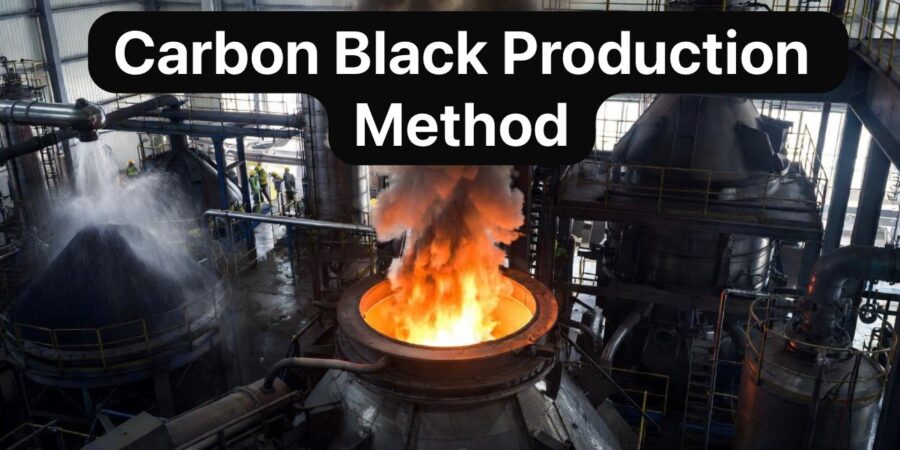
Carbon black is produced by breaking down hydrocarbons under controlled conditions. The main production methods differ in how the raw material is decomposed and how the particles are formed.
- Furnace Black Process (most common)
Overview: The dominant industrial method.
How it works: Heavy petroleum oils (like residual oils) are injected into a high-temperature combustion chamber with limited oxygen.
Process type: Incomplete combustion.
Conditions: ~1400–2000°C.
Control factors: Air-to-fuel ratio, temperature, residence time.
Products: Fine particles with controlled size and structure.
Pros:
Highly controllable properties
Suitable for tire and rubber industries
Cons:
Requires complex equipment
Produces CO₂ and other emissions
- Thermal Black Process
Overview: Uses natural gas instead of oil.
How it works: Natural gas is decomposed in the absence of oxygen in a heated reactor.
Process type: Thermal decomposition (pyrolysis).
Conditions: ~1200–1400°C.
Pros:
Produces larger particle sizes
Lower structure carbon black
Cons:
Lower yield
Less commonly used for reinforcing rubber
- Channel Black Process (historical)
Overview: One of the earliest methods (now mostly obsolete).
How it works: Natural gas flames impinge on cooled metal surfaces, depositing carbon black.
Process type: Incomplete combustion.
Pros:
Produces very fine particles
Cons:
Extremely low efficiency
High environmental impact
Largely discontinued
- Acetylene Black Process
Overview: Produces very pure carbon black.
How it works: Thermal decomposition of acetylene gas.
Process type: Exothermic decomposition.
Conditions: ~800–1000°C.
Pros:
High purity
Excellent electrical conductivity
Cons:
Expensive raw material
Used mainly in batteries and electronics
- Lamp Black Process
Overview: Traditional method.
How it works: Burning liquid hydrocarbons (like tar or oil) with limited air; soot is collected.
Applications: Pigments (inks, paints, art materials).
Pros:
Simple setup
ood tinting strength
Cons:
Poor control over particle size
Labor-intensive
Differences at a Glance
| Method | Feedstock | Main Use | Particle Size | Status |
|---|---|---|---|---|
| Furnace Black | Heavy oils | Tires, rubber | Fine | Dominant |
| Thermal Black | Natural gas | Rubber (non-reinforcing) | Coarse | Limited use |
| Channel Black | Natural gas | Pigments | Very fine | Obsolete |
| Acetylene Black | Acetylene gas | Batteries, electronics | Fine | Specialty |
| Lamp Black | Oils/tars | Pigments, inks | Variable | Niche/traditional |
Summary
The furnace black process dominates modern production due to efficiency and control.
Thermal and acetylene methods serve specialized applications.
Older methods like channel and lamp black are mostly historical or niche today.

Leave a Reply