

Aras Gulf Petrochemicals Company as one the main manufacturer and supplier of different grades of Bitumen Emulsion is supplying all grades of the Emulsified Bitumen for all industrial uses such as Asphalt , Coating, waterproofing and asphalt paving.
Emulsified Bitumen is a mixture of bitumen (asphalt), water, and an emulsifying agent. Since bitumen and water don’t naturally mix, an emulsifier is added to keep tiny droplets of bitumen dispersed in water.
It is widely used in road construction and maintenance because it can be applied at lower temperatures than hot bitumen.
Emulsion Bitumen Composition
Bitumen, Binding material (usually 40–70%)
Water – 30–60%
Emulsifier – 0.2–2% (keeps mixture stable)
Types of Bitumen Emulsion
Based on electrical charge:
1. Cationic (Positive charge)
Most commonly used
Bonds well with negatively charged aggregates
Example grades: RS-1, RS-2, MS, SS2.
Anionic (Negative charge)
Used with positively charged aggregates
Less common in modern road work
Based on setting time:
1. Rapid Setting (RS) Used for surface dressing
2. Medium Setting (MS) Used for premix work
3. Slow Setting (SS) Used for slurry seal and stabilization
Bitumen Emulsion Uses
Tack coat
Prime coat
Surface dressing
Slurry seal
Cold mix asphalt
Soil stabilization
Pothole repair
Emulsion Bitumen Advantages
No heating required (energy efficient)
Safer handling
Environmentally friendly (lower emissions)
Can be applied on damp surfaces
Good adhesion
Emulsion Bitumen Disadvantages
Limited shelf life
Sensitive to freezing
Requires proper curing (water must evaporate)
Emulsion Bitumen Applications
1. Road Construction & Maintenance
Prime Coat
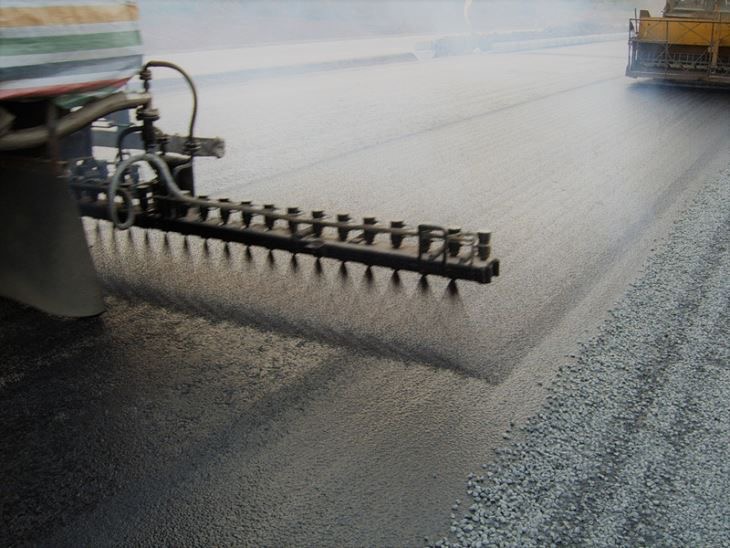
Applied on granular base (WMM/WBM) before laying asphalt.
Helps bind loose particles.
Improves adhesion between base and asphalt layer.
Tack Coat
Sprayed between existing pavement and new asphalt layer.
Ensally ensures strong bonding between layers.
Surface Dressing (Chip Seal)
Sprayed on road surface followed by stone aggregates.
Used for rural roads and low-traffic roads.
Provides waterproofing and skid resistance.
Slurry Seal
Mixture of emulsion, fine aggregates, filler, and water.
Used for preventive maintenance.
Seals cracks and improves surface texture.
Micro Surfacing
Similar to slurry seal but polymer-modified.
Used on highways and heavy traffic roads.
Improves rut resistance and surface life.
2. Cold Mix Asphalt
Used where hot mix plants are not available.
Ideal for:
Pothole repairs
Remote area road works
Temporary road works
3. Soil Stabilization
Mixed with soil to improve:
Strength
Water resistance
Durability
Used in rural roads and sub-base construction.
4. Crack Sealing
Emulsion-based sealants used to fill small cracks.
Prevents water infiltration and pavement damage.
5. Fog Seal
Light application over existing a
Overview
Features:
- Bitumen Emulsion
- Emulsion Bitumen
- Emulsion Asphalt
Seller Information

Leave feedback about this